What is ABV (Alcohol by Volume)?
ABV is just a percentage. It tells you how much of your total liquid is pure ethanol.
A beer with 5% ABV? Five percent of that bottle is alcohol. The rest is water, flavor compounds, whatever else made it through fermentation.
Here's roughly what to expect:
- Beer: 4–6% for most styles, though some get way higher
- Wine: 12–15% typically
- Spirits: 40% and up
That's the standard measurement worldwide. You'll see it on every bottle at the store. When you're making your own stuff, you need to calculate it yourself.
Some people confuse ABV with proof. They're related. Proof is just ABV times two. So 40% ABV equals 80 proof. Americans use proof sometimes. Most of the world just uses ABV.
How to Use the ABV Calculator
Pretty straightforward.
- Take a gravity reading before fermentation starts. That's your Original Gravity. Write it down.
- Wait for fermentation to finish completely.
- Take another reading. That's your Final Gravity.
- Plug both numbers into the calculator above.
- Done.
The calculator does the multiplication for you. Instantly.
Example values to test:
- OG: 1.050
- FG: 1.010
- Result: 5.25% ABV
Most hydrometers read to three decimal places. So you'll see something like 1.048 or 1.052. Enter it exactly as you read it.
What is Original Gravity (OG)?
Original Gravity measures the sugar content before fermentation.
More sugar means more potential alcohol. Yeast eats sugar and makes alcohol. So the starting gravity tells you what you're working with.
You measure it with a hydrometer or refractometer. Drop the hydrometer in your wort or must, read where the liquid hits the scale. That's your OG.
Typical readings:
- Light beers: 1.035–1.045
- Standard ales: 1.045–1.060
- High-gravity stuff: 1.070–1.090+
- Wines: 1.080–1.100+
Higher numbers mean more sugar. More sugar means higher potential ABV. Pretty linear relationship there.
Take this reading after you've mixed everything but before you pitch your yeast. Once fermentation starts, the number drops.
What is Final Gravity (FG)?
Final Gravity is what's left after fermentation.
The yeast consumed most of the sugar. But not all of it. Some sugars aren't fermentable. Some stick around for body and mouthfeel.
You measure FG the same way — hydrometer or refractometer. But you wait until fermentation is actually done. Not just slowed down. Done.
How do you know it's done? Take readings two or three days apart. If the number doesn't change, you're finished.
Typical FG readings:
- Dry beers: 1.006–1.012
- Medium body: 1.012–1.016
- Sweet wines: 1.016–1.024
Lower FG means drier taste and higher ABV. The yeast ate more sugar.
Don't rush this measurement. If you bottle while fermentation is still going, you get bottle bombs. Not fun.
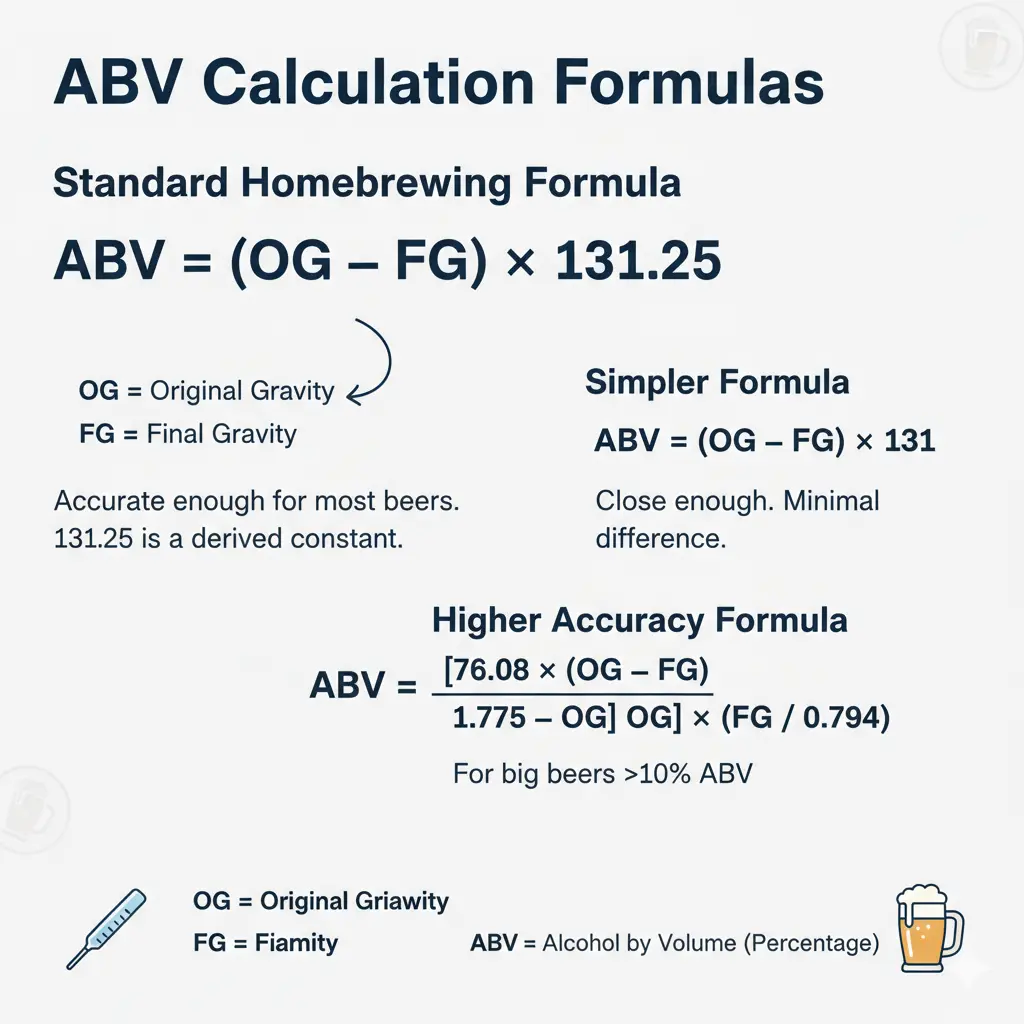
ABV Calculation Formula
The standard formula most homebrewers use:
Standard formula
ABV = (OG − FG) × 131.25
That's it. Subtract Final Gravity from Original Gravity. Multiply by 131.25.
Where does 131.25 come from? It's derived from the relationship between specific gravity points and alcohol production. One gravity point roughly equals… actually, I won't bore you with the chemistry. It just works.
There's also a simpler version:
ABV = (OG − FG) × 131
Close enough for most purposes. Difference is minimal.
And there's a more complex formula for higher accuracy:
Higher accuracy formula
ABV = (76.08 × (OG − FG) / (1.775 − OG)) × (FG / 0.794)
This one accounts for alcohol's effect on specific gravity at higher concentrations. Matters more for big beers and wines over 10% ABV. For your typical 5% ale? The simple formula works fine.
I use the standard 131.25 version. It's accurate enough for homebrewing and I can actually remember it.
Step-by-Step: How to Calculate ABV Manually
Let's work through an example.
Say you brewed an amber ale. You measured:
- OG: 1.050
- FG: 1.010
Manual calculation
Step 1: Subtract FG from OG 1.050 − 1.010 = 0.040
Step 2: Multiply by 131.25 0.040 × 131.25 = 5.25
Result: 5.25% ABV
That's a nice sessionable ale. Nothing crazy.
Another example. Big imperial stout:
- OG: 1.090
- FG: 1.020
Quick math
1.090 − 1.020 = 0.070, then 0.070 × 131.25 = 9.19% ABV
Now you're getting into sipper territory.
The math isn't hard. But it's easy to mess up decimal places when you've been brewing all day. That's why calculators exist.
Why Calculate ABV?
Because guessing isn't good enough.
You put work into this batch. You want to know what you made. Plus there are practical reasons.
For one, you can tell if fermentation actually worked. If your calculated ABV is way lower than expected, something stalled — stuck fermentation, yeast health issues, temperature problems. The number tells you something went wrong.
It also matters for recipes. You want to hit the same ABV every time you brew your house IPA? You need to track your numbers. Otherwise you're just hoping.
And honestly? You should know what you're drinking. There's a real difference between a 4.5% lager and a 9% barleywine — both in how they taste and how they hit.
For Homebrewers
You're brewing for yourself, maybe friends and family. Nobody's checking your labels.
But you still want to know your ABV because:
Fermentation tracking.Did the yeast finish the job? If you expected 6% and calculated 3%, something's off. Maybe the yeast crapped out. Maybe your OG reading was wrong. Either way, you need to investigate.
Recipe refinement. Hit your target numbers and your beer tastes great? Write it down. Miss the mark? Figure out why. ABV tracking over multiple batches shows you patterns.
Competitions.Enter a homebrew competition and they'll ask for your ABV. You need to know.
Drinking responsibly.Your buddy asks how strong that imperial stout is. "Uh, pretty strong I think" isn't a great answer when he's driving later.
For Commercial Brewers & Distillers
This is where ABV calculation stops being optional.
Legal requirements.The TTB in the US (and equivalent agencies elsewhere) require accurate ABV labeling. There's a tolerance range, but you have to be within it.
Taxes. Higher ABV often means higher excise taxes. You need accurate numbers for compliance.
Consistency. Customers expect your flagship IPA to taste the same every time. Same ABV is part of that. Quality control depends on tracking these numbers batch after batch.
Labeling.That percentage on the can isn't a guess. It's a measured, calculated, documented number that regulators can verify.
Commercial operations often use more sophisticated methods — lab analysis, density meters, that kind of thing. But the fundamental calculation is the same.
ABV Calculator for Different Beverages
Same calculator, different contexts.
The math doesn't change. Sugar becomes alcohol. Measure before and after. Calculate the difference.
But each beverage type has quirks worth knowing about.
Beer ABV Calculator
Beer spans a huge range. Light lagers around 3–4%. Session IPAs at 4–5%. Standard ales at 5–6%. And then things get interesting.
Double IPAs, imperial stouts, barleywines — those hit 8–12% ABV. Some Belgian quads push even higher.
Typical gravity ranges for beer:
- OG: 1.035 to 1.100+
- FG: 1.006 to 1.020
High-gravity beers need special attention. Yeast stress becomes a factor over 8% or so. Some strains can't handle it. You might need to select alcohol-tolerant yeast and maybe step-feed fermentable sugars.
But the ABV calculator works the same regardless. Plug in your numbers, get your percentage.
Wine ABV Calculator
Wine starts with more sugar than beer. Grapes are sweeter than grain.
Typical wine ABV: 9–16%
OG readings often fall between 1.080 and 1.110. Sometimes higher for dessert wines.
Final gravity depends on style. A bone-dry wine might finish at 0.990 (yes, below 1.000 — alcohol is less dense than water). A sweet wine could finish at 1.020 or more with residual sugar.
Fermentation takes longer with wine. Weeks instead of days. Sometimes months.
The calculator handles it fine. Just remember that residual sweetness in the FG reading affects your result. A wine that finished at 1.015 because fermentation stopped has different character than one that finished at 0.995 and was back-sweetened.
Mead ABV Calculator
Mead is basically honey wine. And it can go extremely high.
Typical ABV: 8–20%
Honey is almost pure sugar, so your starting gravities get ridiculous. OG of 1.120? Normal for mead. 1.140? Sure, if you want something massive.
Final gravity varies wildly. Dry meads finish low. Sweet traditional meads might stop at 1.030 with the yeast tapping out from alcohol toxicity.
Fermentation takes forever. I mean months. Sometimes a year for high-gravity stuff.
The calculator works. Same formula. But expect numbers you wouldn't see with beer. And know that yeast selection matters even more here — you need something alcohol-tolerant.
Spirits & Distilled Beverages
Here's where things get different.
Pre-distillation, the calculator works normally. Your fermented wash or beer might come out at 8–15% ABV depending on what you're making.
But distillation concentrates alcohol. You're not creating new alcohol — you're separating what's already there. Post-distillation ABV depends on how you run your still, how many times you distill, and where you make your cuts.
After distillation, you use a proofing hydrometer. Regular brewing hydrometers won't work. Different scale, different purpose.
Quick conversion
Proof = ABV × 2
So 40% ABV whiskey is 80 proof.
This calculator is for fermentation, not distillation. Use it for your wash. Use different tools for your finished spirit.
Can I calculate ABV without a hydrometer?
Sort of. But it's not ideal.
Refractometer. Works for OG. Final gravity readings need correction because alcohol throws off the reading. There are calculators for that conversion, but it adds a step and potential error.
Recipe estimation.Software like BeerSmith or Brewfather can estimate ABV based on your grain bill and efficiency. It's a guess though. An educated guess, but still.
Lab testing. Send a sample somewhere. Expensive and slow, but accurate.
Honestly? Just get a hydrometer. They're like ten dollars. There's no good reason to skip this measurement. Everything else is more complicated and less accurate.
How accurate is the ABV calculator?
Pretty accurate for typical fermentations.
The standard formula hits within about 0.5% ABV for most beer and wine. Good enough for homebrewing. Good enough for most purposes.
Accuracy depends on your measurements though. If your hydrometer reading is off by 0.002 specific gravity, your ABV calculation shifts by about 0.26%. That adds up if you're sloppy with readings.
For very high gravity fermentations (big wines, meads, high-ABV beers), the alternate complex formula is technically more accurate. But we're talking small differences — maybe 0.3–0.5% at most.
Commercial operations use lab analysis for exact numbers. For homebrewing? The calculator is plenty accurate.
Does temperature affect ABV?
Temperature doesn't change the actual alcohol content. What's in the bottle is what's in the bottle.
But temperature absolutely affects your gravity readings.
Hydrometers are calibrated for a specific temperature — usually 60°F or 68°F depending on the model. If your sample is warmer or colder, the reading is off.
You can use correction calculators or charts. Or just let your sample cool to the calibration temp before measuring. I usually go the lazy route and pull a sample early, let it sit while I do other stuff.
Fermentation temperature also affects how much alcohol you end up with. Warmer fermentation can stress yeast and leave more residual sugar. Cooler fermentation often means cleaner, more complete fermentation. But that's about the process, not the measurement.
What's a good ABV for homebrewing?
Depends on what you want.
Starting out? Stay in the 4–6% range. It's forgiving. Yeast handles it easily. Fermentation finishes in reasonable time. And you can drink more without falling over.
The "session" range (3–4.5%) is great for everyday drinking beer. Takes skill to make flavorful beer at low ABV though.
Higher ABV (7%+) requires more care. Yeast health matters more. Pitching rates matter more. Temperature control matters more. Things can go wrong that wouldn't at lower gravity.
And check your local laws. In some places homebrew has ABV limits. The US federal limit is technically no limit for personal use, but some states have restrictions.
Can I increase ABV after fermentation?
Yeah, a few ways.
Add more sugar and yeast. If fermentation finished but you want higher ABV, add fermentable sugar (dextrose, honey, etc.) and potentially more yeast. The yeast will kick back up. Works best if you planned for this and your yeast strain can handle higher alcohol.
Fortification. Add spirits. Port and sherry work this way. Stops fermentation and bumps up ABV. Changes the character completely though. And depending where you are, might have legal implications even for personal use.
Blending. Mix with a higher ABV batch. Commercial breweries do this for consistency. Works if you have multiple batches.
Usually though? Just hit your target the first time. Plan the recipe for the ABV you want. Boosting after the fact is a fix, not a technique.