
What is an RV Loan Calculator?
An RV loan calculator is basically a financial tool that does math you don't want to do yourself.
You enter a few key details—how much the RV costs, what you're putting down, the interest rate, and how long you want to finance it. The calculator crunches those numbers and tells you what your monthly payment would be.
It also shows your total loan cost. That's the part that tends to wake people up. Because a $50,000 RV financed over 15 years at 8% interest? You're paying way more than $50,000 by the time you're done.
People use these calculators to figure out if they can actually afford a specific RV. Or to compare different scenarios—like what happens if I put $10,000 down instead of $5,000? What if I go with a 10-year term instead of 20?
It's a budget planning tool. Simple as that. But surprisingly powerful when you actually use it.
How Does an RV Loan Calculator Work?
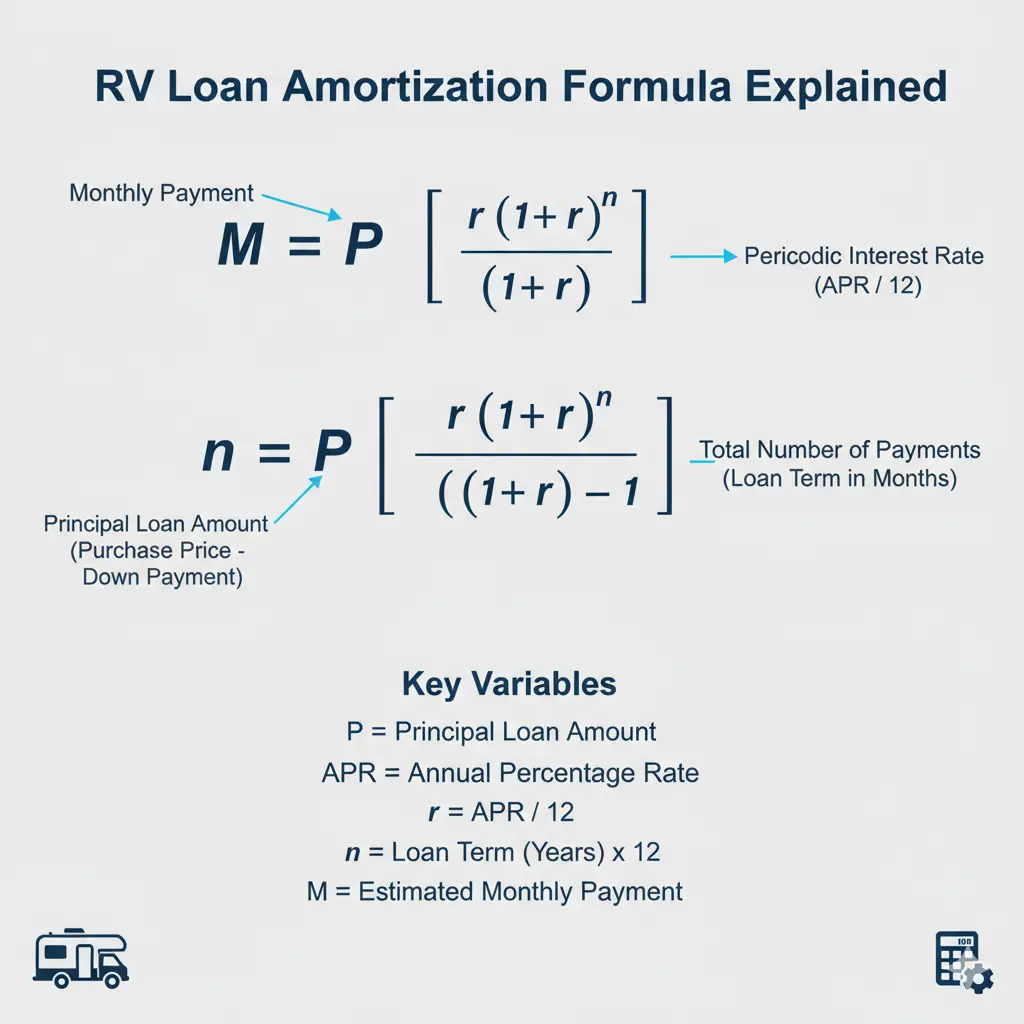
Behind the scenes, the calculator uses a standard loan amortization formula. Same formula banks use when they calculate your payment.
Here's what goes into it:
Principal amount— That's the amount you're actually borrowing. Purchase price minus your down payment.
Annual interest rate (APR) — The percentage the lender charges you for borrowing the money. This gets divided by 12 for monthly calculations.
Loan term in months— How long you're financing. A 15-year loan is 180 months.
Down payment— Cash you're putting up front. Reduces the principal.
Amortization formula
M = P [ r (1 + r)^n ] / [ (1 + r)^n − 1 ]
M = payment per period
P = principal (loan amount)
r = periodic interest rate
n = number of payments
Don't worry about memorizing that. The calculator does it for you.
Let me give you a real example. Say you're buying a $40,000 travel trailer. You put $8,000 down, so you're financing $32,000. Interest rate is 7%, loan term is 12 years (144 months).
Your monthly payment comes out to around $310. And your total interest paid over those 12 years? About $12,600.
So that $40,000 trailer actually costs you around $52,600 when all is said and done.
That's the kind of clarity these calculators provide.
Why Use an RV Loan Calculator?
There are a lot of reasons. Here are the ones that matter most:
- Budget planning— You know exactly what you're committing to each month before you buy anything.
- Compare loan scenarios— What's the difference between a 10-year and 15-year loan? You can see it instantly.
- Understand the true cost — That sticker price is only part of the story. Interest adds up.
- Save time at the dealership — Walk in knowing what you should be paying. No surprises.
- Negotiate better— When you've already done the math, you're harder to push around.
- Figure out your price range — Work backward from a monthly payment you can afford.
- See how down payment changes things — Sometimes putting an extra $5,000 down saves you $10,000 in interest.
- Compare loan terms side by side — 20-year loans look cheap monthly but cost a fortune total.
I've seen people completely change their minds after running the numbers. They wanted the big Class A, ran the calculator, and realized a Class C made way more sense financially. Nothing wrong with that. Better to know now than regret it later.
Key Factors That Affect Your RV Loan Payment
Your monthly payment isn't random. It's determined by a handful of variables, and each one has a real impact on what you'll pay. Change one, and the whole picture shifts.
Let's break them down.
1. RV Purchase Price
This is the starting point. Everything else flows from here.
RV prices vary wildly depending on what you're looking at:
- Travel trailers: $15,000 – $50,000
- Fifth wheels: $30,000 – $100,000
- Class C motorhomes: $60,000 – $150,000
- Class B camper vans: $60,000 – $150,000
- Class A motorhomes: $100,000 – $500,000+
The higher the price, the higher your monthly payment. Obviously. But people sometimes forget how much a $10,000 difference in price actually affects things over a 15-year loan.
New vs used matters here too. A 3-year-old used RV might cost 30–40% less than new. Same basic RV, dramatically different payment.
2. Down Payment Amount
Most lenders want 10–20% down on an RV loan. Some require at least 10%.
But here's the thing—putting more down helps you in multiple ways.
First, it reduces your loan amount. Lower principal means lower monthly payment.
Second, it reduces total interest. You're not paying interest on money you didn't borrow.
Third, it can get you better loan terms. Lenders see less risk when you have more skin in the game.
Let's say you're buying a $60,000 fifth wheel. Put 10% down ($6,000), and you're financing $54,000. Put 20% down ($12,000), and you're financing $48,000.
That $6,000 difference in down payment saves you probably $8,000–$10,000 in interest over a 15-year loan. Worth thinking about.
3. Interest Rate (APR)
APR is the annual percentage rate you pay for borrowing the money. It's the lender's profit, basically.
Current RV loan rates typically range from around 4% on the low end to 15% or higher on the high end. That's a huge range.
What determines your rate?
- Credit score— Biggest factor. 750+ gets you the best rates. Below 650, you're paying a premium.
- Loan term — Longer terms sometimes carry slightly higher rates.
- New vs used RV — Used RVs often have higher rates than new.
- Lender type — Banks, credit unions, and RV specialty lenders all price differently.
- Loan amount — Very small loan amounts sometimes have higher rates.
Here's what people don't realize: small rate differences add up fast.
On a $50,000 loan over 15 years, the difference between 6% and 8% interest is over $10,000 in total interest paid. Two percentage points. Ten thousand dollars.
Shop around.
4. Loan Term Length
RV loans typically run 10–20 years. That's longer than car loans, which usually max out around 7 years.
Longer terms mean lower monthly payments. That's the appeal. A 20-year loan on a $75,000 RV might be $450/month. A 10-year loan on the same RV could be $750/month.
But there's a trade-off.
Longer terms mean more total interest. Way more. That 20-year loan might cost you $30,000 in interest. The 10-year loan might cost $15,000.
You're basically deciding: do I want lower monthly payments, or do I want to pay less overall?
Neither answer is wrong. It depends on your cash flow and priorities. But you should know what you're choosing.
5. Trade-In Value
If you're trading in an existing RV or vehicle, that value gets subtracted from your purchase price.
Basically, it works like an extra down payment.
Trading in a vehicle worth $8,000? That's $8,000 less you need to finance.
How do you know what your trade-in is worth? Check Kelley Blue Book, NADA Guides, or get quotes from dealers. RVs depreciate fast, especially in the first few years, so don't assume your 5-year-old trailer is worth what you paid.
6. Sales Tax and Fees
This is where people get caught off guard.
Beyond the RV price, you're also paying:
- Sales tax— Varies by state. Some charge 6–8% or more. On a $100,000 RV, that's $6,000–$8,000.
- Registration fees — Depends on the state and RV type.
- Documentation fees — Dealership paperwork charges. Usually a few hundred dollars.
- Dealer fees — Prep fees, delivery fees, whatever they want to call them.
You can pay these costs upfront, or you can roll them into the loan.
Rolling them in means financing a higher amount. Which means higher monthly payments and more interest.
Something to factor into your calculator inputs.
Types of RVs and Typical Loan Amounts
Different RV types mean very different price tags. And that directly affects what your loan looks like. Here's a quick breakdown.
Travel Trailers
These are the most affordable entry point into RVing.
Price range: $15,000 – $50,000 typically. Some smaller or older ones go lower. Luxury models higher.
Typical loan amount: $12,000 – $45,000 after down payment.
Average monthly payments: Could be anywhere from $150 to $400, depending on term and rate.
You tow these with an SUV or truck. No engine to maintain. Good starter option for a lot of people.
Fifth Wheel Trailers
Step up from travel trailers. More space, usually more features.
Price range: $30,000 – $100,000 for most models.
Typical loan amount: $25,000 – $90,000.
Average monthly payments: $250 – $700 range, roughly.
You need a truck with a fifth wheel hitch to tow these. They're heavy. Factor that cost in if you don't already have the right vehicle.
Class A Motorhomes
The big ones. Bus-style. These are the most expensive RVs on the road.
Price range: $100,000 – $500,000+. High-end diesel pushers can hit $700,000.
Typical loan amount: $80,000 – $400,000+.
Average monthly payments: $700 – $3,000+.
You're basically financing a house on wheels. Luxury features, full kitchens, washer/dryers, sometimes multiple TVs.
Lots of people finance these over 15–20 years because that's the only way to make the payment manageable.
Class B Motorhomes (Camper Vans)
These are the compact option. Built on van chassis.
Price range: $60,000 – $150,000 for new ones.
Typical loan amount: $50,000 – $135,000.
Average monthly payments: $400 – $1,000.
They're growing in popularity. More maneuverable than bigger motorhomes. Easier to park. Some people use them as daily drivers.
Limited space though. You're making trade-offs.
Class C Motorhomes
The ones with the cab-over bunk. Built on truck or van cutaway chassis.
Price range: $60,000 – $150,000 typically.
Typical loan amount: $50,000 – $135,000.
Average monthly payments: $400 – $1,000.
Good middle ground between Class B and Class A. More livable space than a camper van, more drivable than a giant bus.
A lot of families start here.
How to Use the RV Loan Calculator: Step-by-Step Guide
Okay, let's walk through actually using this thing. It's not complicated, but getting accurate inputs makes a difference.
Step 1: Enter the RV Purchase Price
Start with the total price of the RV you're considering.
If you're looking at a specific unit, use that exact number. Include any add-ons, upgrades, or packages the dealer is quoting.
If you're just exploring, use realistic prices for the type of RV you want. Don't lowball it.
Tip: If you're working with a dealer, ask for an "out the door" price. That's more accurate than the sticker.
Step 2: Input Your Down Payment
Enter what you plan to put down. Either as a dollar amount or a percentage.
Start with what you actually have saved. Then try different numbers to see how they affect the payment.
What happens if you wait 6 months and save another $5,000? Run that scenario. Might be worth the wait.
Step 3: Add the Interest Rate
This is where you need to do a little homework.
If you've been pre-approved by a lender, use that rate. That's your real number.
If you haven't, estimate based on your credit score:
- 750+: Try 5–7%
- 700–749: Try 7–9%
- 650–699: Try 9–12%
- Below 650: Try 12–15%
These are rough ranges. The calculator lets you test different rates, so try a few to see how sensitive your payment is to rate changes.
Step 4: Select Your Loan Term
Choose how long you want to finance.
Options usually range from 5 to 20 years. Shorter loans for cheaper RVs, longer loans for expensive ones.
I'd recommend running the calculator at multiple term lengths. A 10-year term versus a 15-year term versus a 20-year term. Compare the monthly payments and total interest for each.
Sometimes the sweet spot isn't the longest or shortest option.
Step 5: Include Trade-In Value (Optional)
If you're trading in a vehicle or existing RV, enter that value here.
This reduces the amount you need to finance.
Use a realistic trade-in value. What the dealer is actually offering, or what comparable units are selling for. Not what you hope to get.
Step 6: Add Sales Tax and Fees
Estimate your taxes and fees and add them to the calculation.
Sales tax: Look up your state's rate. Apply it to the RV purchase price.
Fees: Estimate $500–$1,500 for dealer fees, documentation, etc.
If you're financing these costs, include them. If you're paying them out of pocket separately, leave them out.
Step 7: Calculate and Review Results
Hit the calculate button.
Now you'll see:
- Monthly payment— What you'll pay each month.
- Total amount paid — Principal plus all interest over the life of the loan.
- Total interest — Just the interest portion. This number often surprises people.
- Amortization schedule (if available) — Shows how each payment splits between principal and interest over time.
Look at all of it. Not just the monthly payment. The total interest tells you the real cost of the loan.
What credit score do I need for an RV loan?
Most lenders want at least 650. That's kind of the floor for standard RV financing.
720 or higher gets you the good rates. That's where you start seeing offers in the 5–7% range.
Below 650? You'll probably still find someone willing to lend to you. But expect higher rates, larger down payment requirements, or both.
Credit unions sometimes have more flexible standards than big banks. Worth checking if your score is borderline.
Can I get an RV loan with bad credit?
Yes. It's possible. But it's going to cost you.
Expect:
- Higher interest rates (12–18% or more)
- Bigger down payment requirements (20–30%)
- Shorter loan terms
- Possible co-signer requirement
Some lenders specialize in bad credit RV loans. Credit unions can be more forgiving than banks.
Honestly though? If your credit is rough, it might be worth waiting 6–12 months to improve your score before buying. The rate difference can save you thousands.
What is a good interest rate for an RV loan?
Right now, anything under 6% is pretty good.
If you've got excellent credit (750+) and you're buying a new RV, you might see rates in the 5–6% range from the right lender.
Good credit (700–749) usually lands somewhere in the 6–9% range.
Fair credit (650–699) is typically 9–12%.
Rates change with market conditions though. What's "good" today might be different in a year. The important thing is comparing multiple offers and picking the best one you qualify for.
How much should I put down on an RV?
Standard advice is 10–20%.
20% down is ideal. It gets you better loan terms, lower payments, less interest overall.
10% is usually the minimum for many lenders.
Can you put down less? Sometimes. But you'll pay for it in higher rates and more interest over time.
If you have a trade-in, that can count toward your down payment. Helps a lot if you're short on cash.
What is the average monthly payment on an RV?
This varies way too much to give a single number.
A $20,000 travel trailer financed over 10 years at 7%? Around $230/month.
A $150,000 Class A financed over 20 years at 6%? Around $1,075/month.
Your payment depends entirely on the RV price, down payment, rate, and term. That's why running the calculator with your specific numbers is so important.
Can I pay off my RV loan early?
Usually, yes.
Most RV loans allow early payoff without penalty. But read your loan agreement to make sure there's no prepayment penalty buried in there.
Paying extra toward principal each month (or making lump sum payments) reduces your total interest and shortens your loan term. Even an extra $50–$100 per month can knock years off the loan.
If you come into money—bonus, tax refund, inheritance—throwing it at the RV loan is often a smart move. Builds equity faster and saves you interest.
Should I finance through the dealer or my bank?
Dealer financing is convenient. You're already there, they handle everything.
But here's what I'd recommend: get pre-approved from your bank or credit union first. Know what rate you qualify for. Then see what the dealer offers.
Sometimes dealers have manufacturer incentives or promotional rates that beat your bank. Sometimes they don't.
Having a pre-approval in your pocket gives you leverage. You're not dependent on whatever rate they throw at you. You can walk away if they can't beat your bank.
Credit unions, in particular, often have excellent RV loan rates. Worth checking before you shop.
How does the loan term affect my monthly payment?
Longer terms mean lower monthly payments.
Shorter terms mean higher monthly payments.
But it's a trade-off. Longer terms mean you pay more total interest. A lot more, sometimes.
Example comparison
- $50,000 loan at 7% for 10 years: ~ $580/month, ~ $19,600 total interest
- $50,000 loan at 7% for 20 years: ~ $387/month, ~ $43,000 total interest
That's a nearly $200/month difference. But you're paying an extra $23,000+ in interest.
Use the calculator to find your balance point. What's the lowest monthly payment you can live with while not destroying yourself on interest?
What's included in my monthly RV loan payment?
Just principal and interest. That's it.
Your RV loan payment doesn't cover:
- Insurance
- Registration and tags
- Storage fees (if you don't keep it at home)
- Maintenance and repairs
- Fuel
- Campground fees
Budget for those separately. They add up. Insurance alone can be $500–$1,500+ per year depending on the RV. Maintenance, fuel, and camping costs vary wildly based on how much you use it.
Can I use an RV loan calculator for a used RV?
Absolutely. Works the same way.
Just enter the used RV's purchase price. Everything else functions identically.
Couple things to know about used RV financing though:
- Interest rates are usually a bit higher than new RV rates
- Maximum loan terms may be shorter (lenders often limit based on RV age)
- Older RVs might not qualify for financing at all if they're past a certain age
But yes, the calculator works for used. Just input accurate numbers for what you're actually buying.