
What is a Cubic Yard?
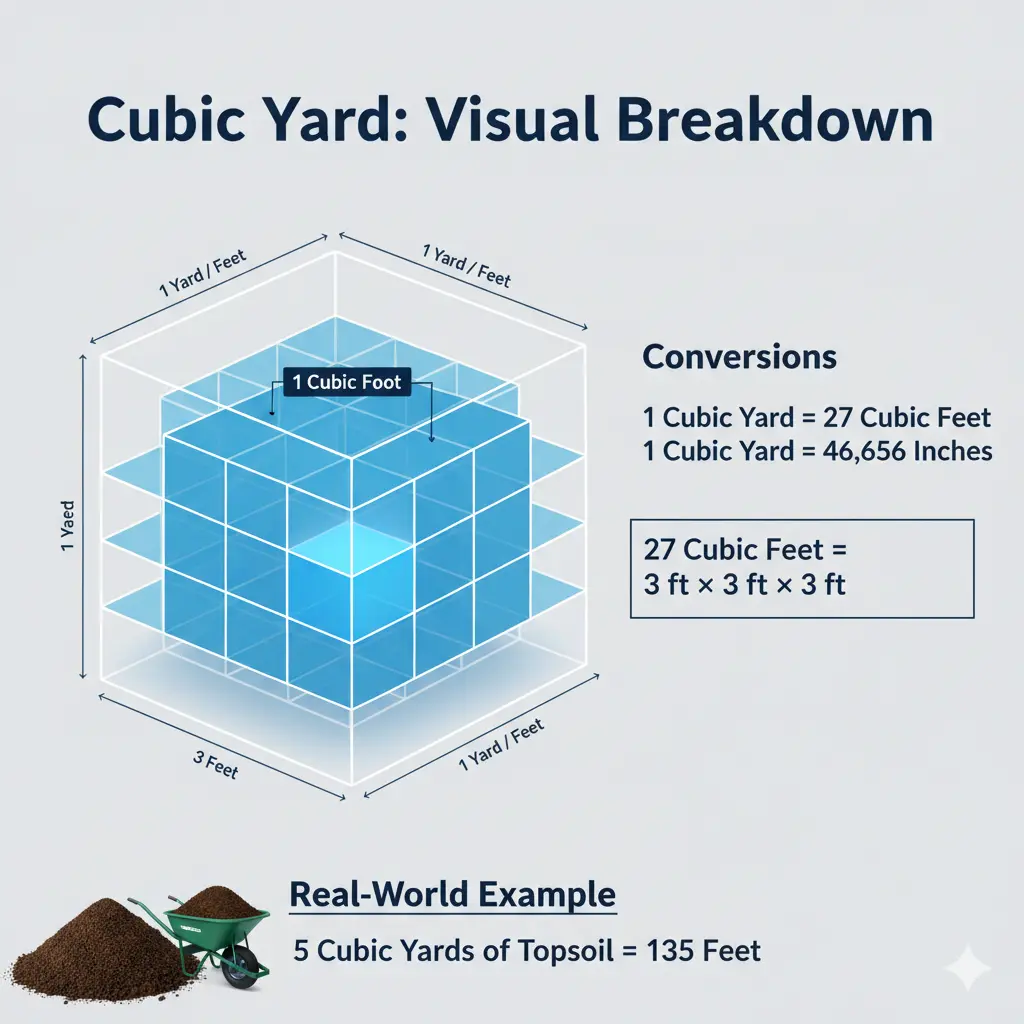
A cubic yard is a box. That's really all it is.
Picture a cube that's 1 yard long, 1 yard wide, and 1 yard tall. That's one cubic yard. Since a yard is 3 feet, you're looking at a cube that's 3 feet in every direction.
Here's where people get tripped up:
- 1 cubic yard = 27 cubic feet
- 1 cubic yard = 46,656 cubic inches
That 27 number is the one you'll use most. It comes from 3 × 3 × 3. Three feet times three feet times three feet.
When someone says "I need 5 cubic yards of topsoil," they're talking about 5 of those boxes. That's 135 cubic feet of dirt. Which is... a lot. More than most people think, actually.
What is a Cubic Yard Calculator?
It's a tool that does one thing really well: takes your length, width, and depth measurements and spits out cubic yards.
No formulas to remember. No division errors. No "wait, did I convert that right?"
You could do this math by hand. But here's the thing — you probably won't do it correctly every time. Especially when you're dealing with weird measurements like 47 inches or 8 feet 3 inches.
The calculator handles all that. It converts units automatically, runs the formula, and gives you a number you can actually use when ordering materials.
DIY homeowners use it for weekend projects. Contractors use it for estimates and material orders. Landscapers use it constantly. Anyone who's ever stood in front of a pile of gravel wondering if they ordered enough — they need this tool.
How Does a Cubic Yard Calculator Work?
The basic formula is simple:
Volume formula
Volume = Length × Width × Height (or Depth)This gives cubic feet. Then divide by 27 to get cubic yards.
So if you have an area that's 10 feet long, 10 feet wide, and 6 inches deep:
10 × 10 × 0.5 = 50 cubic feet50 ÷ 27 = 1.85 cubic yardsThe calculator does this automatically. You just enter measurements.
Most calculators let you input feet, inches, or yards — whatever you have. It converts everything for you. Some even handle centimeters and meters if you're working with metric.
Different shapes need different formulas, but the calculator handles that too. Circles use pi. Triangles use the half-base-times-height thing. You just enter the numbers.
How to Use Our Cubic Yard Calculator
- 1
Select your project type or material. Concrete, mulch, gravel — pick one. Different materials sometimes have different considerations built in.
- 2
Choose your measurement unit. Feet and inches are most common. Use whatever your tape measure shows.
- 3
Enter the length. Measure the longest side of your project area.
- 4
Enter the width. That's the shorter side, going the other direction.
- 5
Enter the depth or height. For mulch, this might be 3 inches. For a concrete slab, maybe 4 inches. For fill dirt, could be several feet.
- 6
Hit calculate.
That's it. You get your cubic yards.
Waste factor tip
One more thing — some calculators let you add a waste factor. Usually 5-10%. This accounts for spills, uneven ground, settling, and general "stuff happens." I always add it. Running short is worse than having a little extra.
Common Projects That Need Cubic Yard Calculations
Almost any project involving bulk materials needs this calculation. Concrete, landscaping, hardscaping — if you're ordering material by volume, you need to know the volume.
Here's where cubic yard calculations come up most often:
1. Concrete Projects
Concrete is sold by the cubic yard. Period. That's how ready-mix trucks work. When you call a concrete company, they ask how many yards you need.
Driveways, patios, sidewalks, slabs, footings, foundations — all measured in cubic yards.
Typical depth for a driveway is 4 inches minimum. Patio slabs are usually 4 inches too. Footings go deeper, often 12 inches or more depending on your local codes and frost line.
Here's a tip that'll save you money and headaches: order 5-10% more than your calculation shows. Concrete trucks charge extra for small orders. And if you run short mid-pour, you're in trouble.
2. Mulch and Topsoil
Garden beds. Flower borders. Around trees. New lawns. Raised beds.
Mulch depth is usually 2-4 inches. Two inches for refreshing existing beds. Three to four inches for new installations or heavy weed suppression.
Topsoil needs vary more. Topping off a lawn might need just an inch. Building a new raised bed could need 8-12 inches.
One thing people forget: mulch and topsoil settle. What looks like 4 inches thick today might be 3 inches in a month. Organic mulches decompose too.
3. Gravel and Stone
Driveways. Walkways. Drainage areas. French drains. Decorative landscaping around patios and fire pits.
Gravel depth depends on use. Decorative gravel paths might only need 2 inches. Driveways need 3-4 inches minimum — more if you're building up a base layer.
Different gravel types have slightly different coverage because of how they pack together. But for ordering purposes, the cubic yard calculation works the same.
Pro tip: gravel is heavy. Make sure whoever's delivering can actually get the truck where you need the pile.
4. Sand
Sandboxes for kids. Base material under pavers. Leveling layer for pool installations. Construction and masonry work.
The sandbox calculation is straightforward — just measure the box dimensions and typical depth is 6-12 inches depending on how deep you want the play area.
Paver base is different. Sand compacts. A lot. What you put down at 1 inch might compact to 3/4 inch.
Talk to your supplier about compaction ratios — they deal with it daily.
5. Dirt and Fill Material
Grading yards. Leveling low spots. Filling holes. Raising ground level. Building berms.
Fill dirt calculations seem simple but there's a catch: compaction. Loose fill dirt takes up more space than compacted fill dirt. Depending on the soil type and how much you compact it, you might need 20-30% more material than your raw calculation suggests.
If you're filling a hole that needs to support weight — like under a future patio — talk to someone who knows soil. Different fill materials compact differently.
Cubic Yard Calculator Formulas for Different Shapes
Not every project is a neat rectangle. Some are circles. Some are triangles. Some are weird blobs that don't match any geometry you remember from school.
Different shapes need different formulas. The calculator handles this, but it's worth understanding what's happening behind the scenes.
Rectangular/Square Area Formula
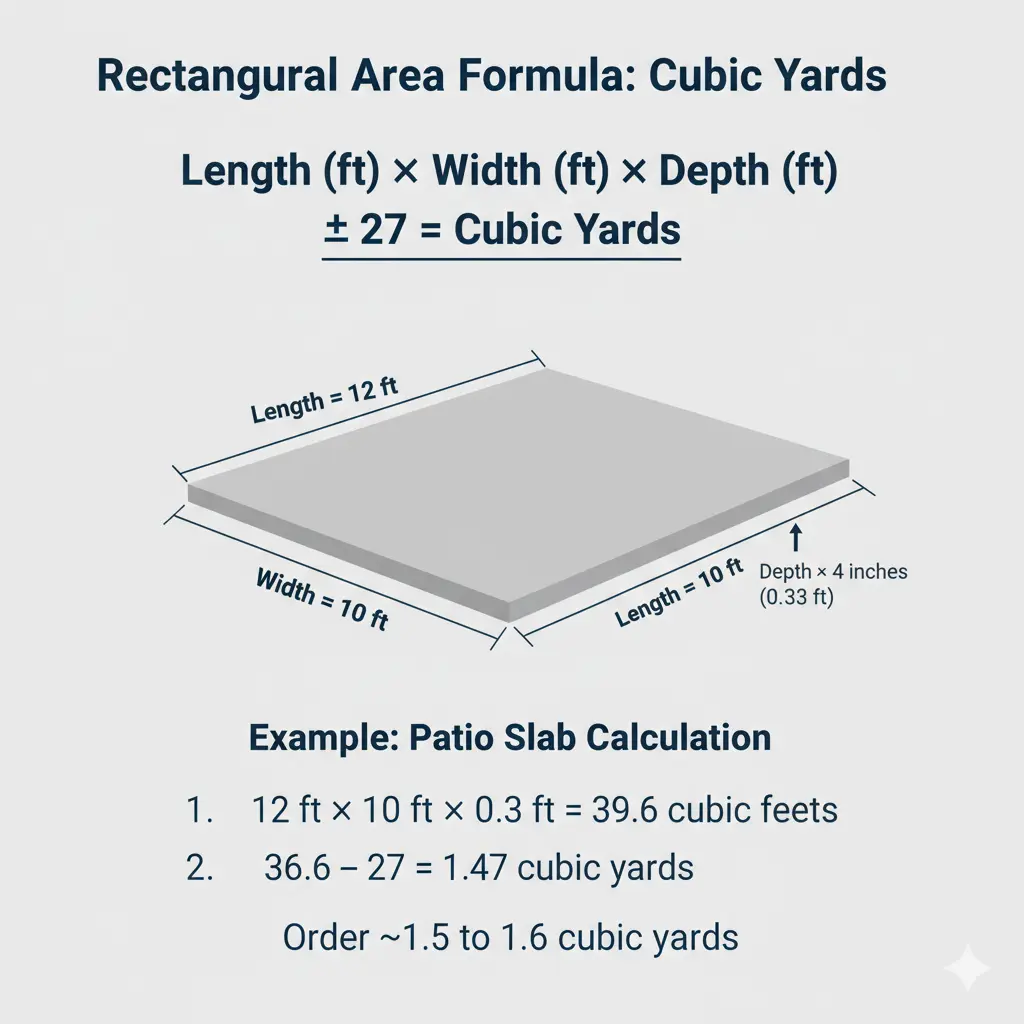
This is the most common one. Probably 80% of projects.
Length (ft) × Width (ft) × Depth (ft) ÷ 27 = Cubic YardsExample: A patio that's 12 feet long, 10 feet wide, and 4 inches deep (that's 0.33 feet).
12 × 10 × 0.33 = 39.6 cubic feet39.6 ÷ 27 = 1.47 cubic yardsYou'd order about 1.5 to 1.6 cubic yards to be safe.
Circular Area Formula
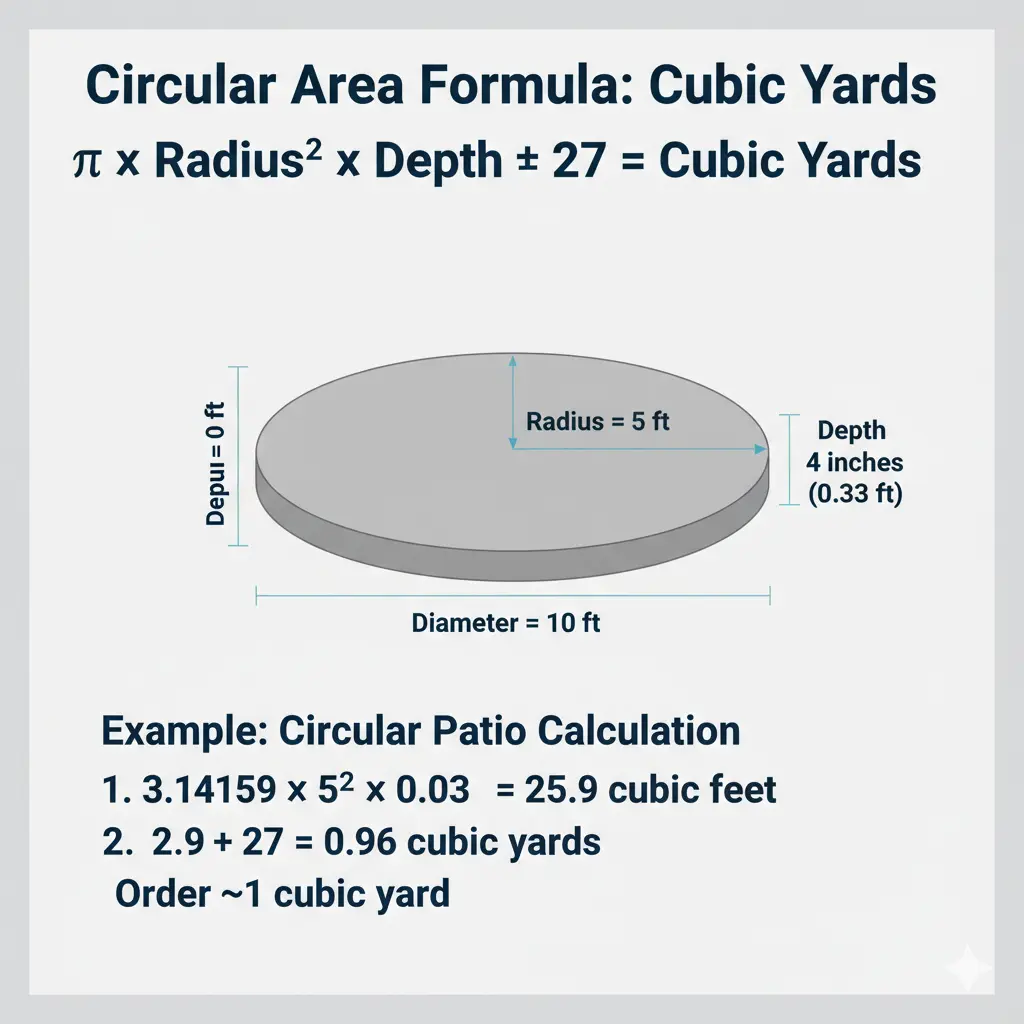
Round patios. Circular planters. Pool surrounds. Fire pit areas.
π × Radius² × Depth ÷ 27 = Cubic YardsRemember: radius is half the diameter. So if your circle is 10 feet across, the radius is 5 feet.
Example: A circular patio 10 feet in diameter, 4 inches deep.
3.14159 × 5² × 0.33 = 25.9 cubic feet25.9 ÷ 27 = 0.96 cubic yardsCall it 1 cubic yard, maybe a touch more.
Triangular Area Formula
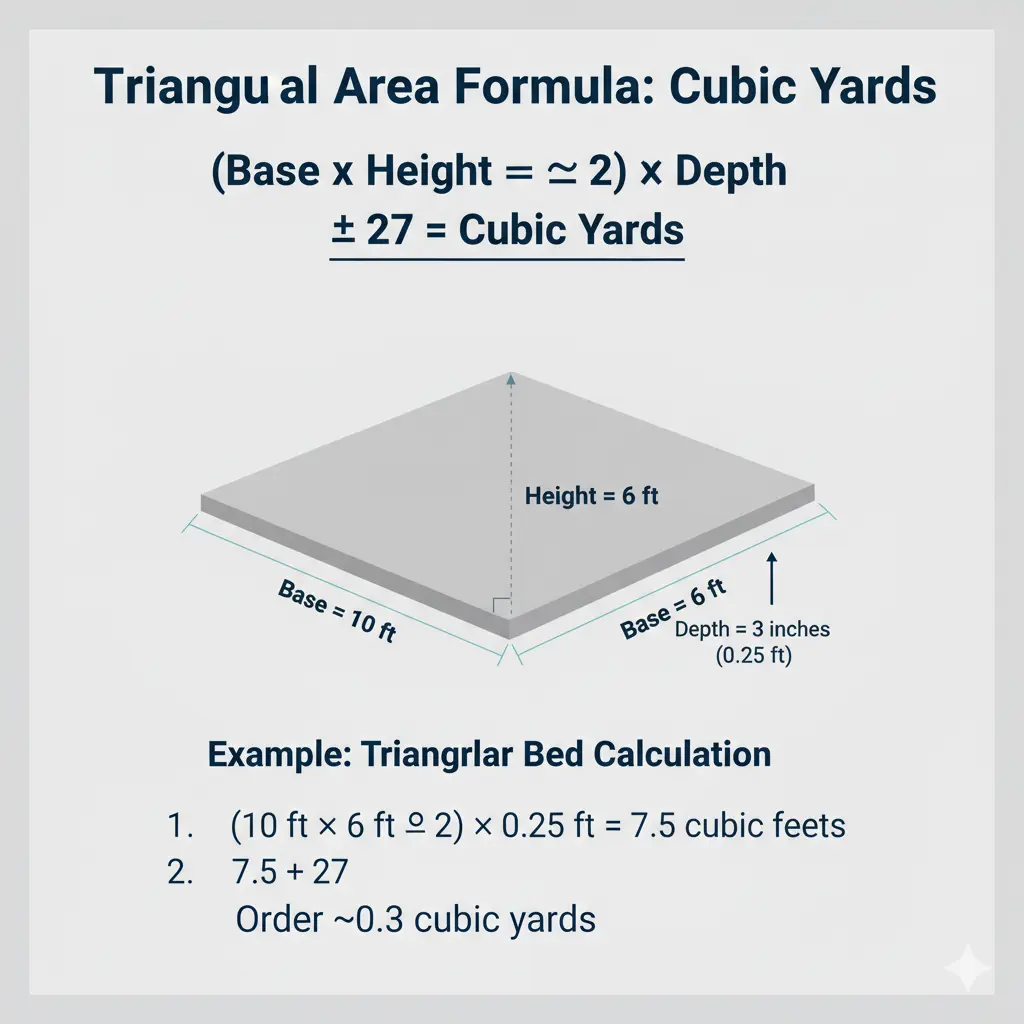
Sloped corner areas. Triangular garden beds. Wedge-shaped spaces between other features.
(Base × Height ÷ 2) × Depth ÷ 27 = Cubic YardsThe "height" here is the triangle height — the perpendicular distance from the base to the opposite point. Not the depth of material.
Example: A triangular bed with a 10-foot base, 6-foot height, and 3-inch mulch depth.
(10 × 6 ÷ 2) × 0.25 = 7.5 cubic feet7.5 ÷ 27 = 0.28 cubic yardsNot a lot. Triangles are smaller than they look.
Irregular Shaped Areas
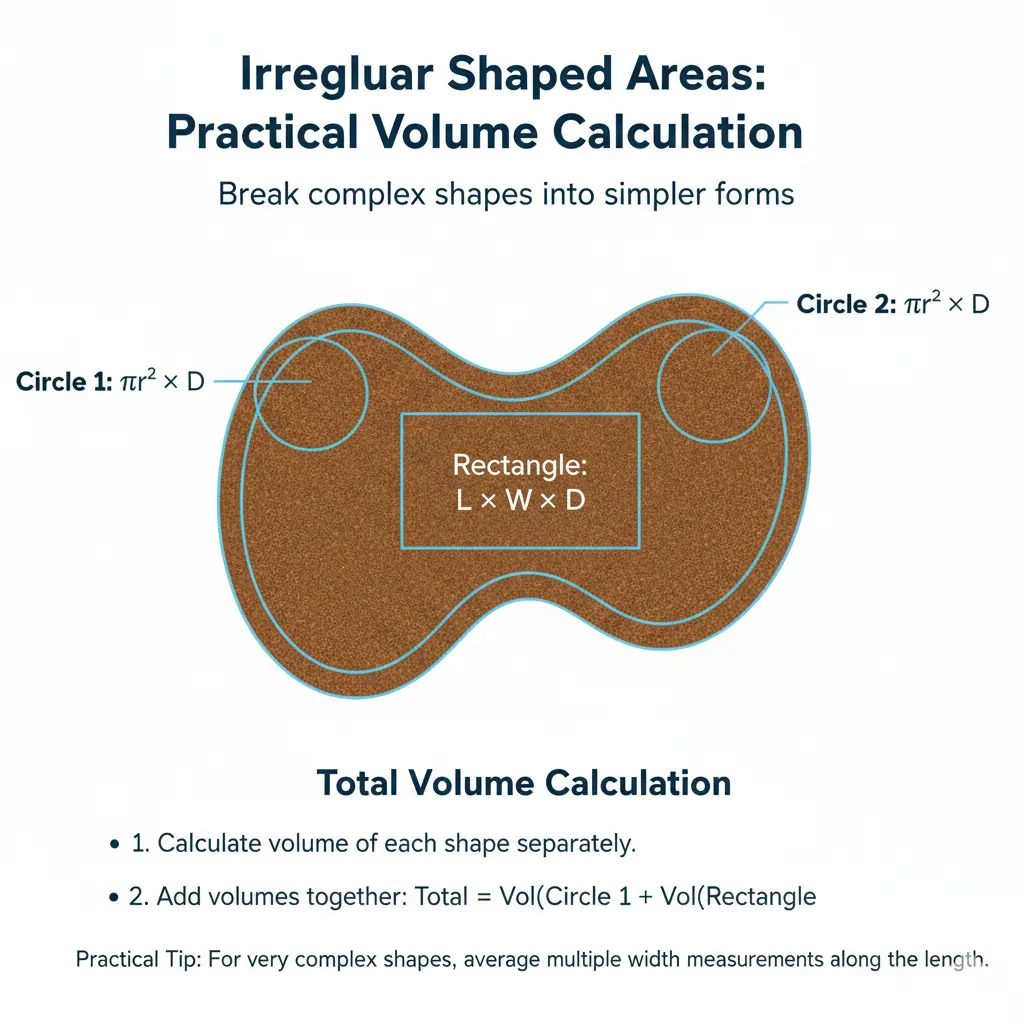
Here's where it gets practical instead of mathematical.
If you have a weird shaped area, break it into shapes you can calculate. A kidney-shaped garden bed might become two circles and a rectangle. An L-shaped patio is two rectangles.
Calculate each piece separately. Add them together. That's your total.
For really irregular areas, sometimes I just measure a bunch of widths at different points, average them, and use that with the length. Not mathematically perfect. But close enough for ordering mulch.
Cubic Yards to Other Unit Conversions
Not everyone sells materials the same way. Concrete comes in cubic yards. Bagged mulch comes in cubic feet. Gravel sometimes sells by the ton. You need to convert between these.
Here are the conversions that actually matter:
Cubic Yards to Cubic Feet
1 cubic yard = 27 cubic feetMultiply cubic yards by 27 to get cubic feet. Divide cubic feet by 27 to get cubic yards.
This one you'll use constantly. Especially when comparing bulk delivery prices to bagged material prices.
Cubic Yards to Tons
This one's tricky because it depends on the material. Different stuff weighs different amounts.
Common conversions:
- Gravel: about 1.4 tons per cubic yard
- Sand: about 1.3 tons per cubic yard
- Topsoil: about 1.1 tons per cubic yard
- Concrete: about 2 tons per cubic yard
These are approximations. Moisture content matters. Gravel type matters. Always check with your supplier — they know what their specific materials weigh.
Cubic Yards to Bags
Bagged materials list volume in cubic feet. Common sizes are 0.5 cubic feet, 1 cubic foot, and 2 cubic feet.
(Cubic Yards × 27) ÷ Bag Size = Number of BagsExample: You need 2 cubic yards of mulch. Bags are 2 cubic feet each.
2 × 27 = 54 cubic feet54 ÷ 2 = 27 bagsThat's a lot of bags. This is why bulk delivery makes sense for bigger projects.
Cubic Yards to Cubic Meters
1 cubic yard = 0.7646 cubic metersYou might need this for international suppliers or if you're working from plans drawn in metric. Multiply cubic yards by 0.7646 to get cubic meters.
How much does a cubic yard cover?
Depends entirely on depth. The shallower you spread it, the more ground you cover.
Coverage per cubic yard:
- 1 inch deep = 324 square feet
- 2 inches deep = 162 square feet
- 3 inches deep = 108 square feet
- 4 inches deep = 81 square feet
- 6 inches deep = 54 square feet
- 12 inches deep = 27 square feet
Coverage formulas
(27 ÷ depth in feet) = square feet covered324 ÷ depth in inches = square feet coveredHow much does a cubic yard weigh?
Varies dramatically by material:
- Wood mulch: 400-800 lbs
- Compost: 800-1,000 lbs
- Topsoil: about 1,080 lbs
- Sand: about 2,600 lbs
- Gravel: about 2,800 lbs
- Wet concrete: about 4,000 lbs
This matters for delivery. It matters for your truck if you're hauling yourself. And it matters for how much you can physically move with a wheelbarrow in an afternoon.
How do I convert square feet to cubic yards?
You can't. Not without knowing the depth.
Square feet is area — two dimensions. Cubic yards is volume — three dimensions. You need that third measurement.
Once you have depth:
Square Feet × Depth (in feet) ÷ 27 = Cubic YardsExample: 500 square feet at 3 inches deep (0.25 feet)
500 × 0.25 ÷ 27 = 4.63 cubic yardsHow many wheelbarrows are in a cubic yard?
Depends on your wheelbarrow and how high you fill it.
Standard wheelbarrow holds 2-3 cubic feet. A cubic yard is 27 cubic feet. That's roughly 9-14 wheelbarrow loads.
Call it 10-12 for planning purposes. And yes, that's a lot of trips. A cubic yard is more material than people think.
Can I calculate cubic yards for irregular shapes?
Yes. Break it up.
Take that weird kidney-shaped bed and mentally cut it into simple shapes. Two half-circles on the ends, rectangle in the middle. Calculate each piece, add them up.
For really wonky areas, measure the width at several points along the length. Average those widths. Then treat it as a simple rectangle with that average width.
Not perfect. But you're ordering mulch, not building a space shuttle. Close enough is fine.
What's the difference between cubic yards and square yards?
Square yards = area (length × width). Two dimensions. Like measuring carpet.
Cubic yards = volume (length × width × depth). Three dimensions. Like measuring how much stuff fits in a box.
You can't convert directly between them. A 10 square yard area could need 0.5 cubic yards of material at shallow depth or 5 cubic yards at deep depth. The third dimension matters.
How many cubic yards fit in a pickup truck?
Less than you think. And weight is usually the limit, not space.
Volume capacity:
- Compact pickup: 1.5-2 cubic yards
- Full-size pickup: 2-3 cubic yards
But weight capacity might stop you first. A full-size truck might physically fit 3 cubic yards of gravel, but that gravel weighs over 4 tons. Way over most truck's payload rating.
Mulch? Sure, fill it up — it's light. Gravel or sand? Check your truck's weight limits first. You can destroy a suspension and void your warranty in one trip.
Do I need to convert inches to feet for calculations?
If you're using the ÷ 27 formula manually, yes. All measurements need to be in feet for that formula to work.
Quick conversions:
- 3 inches = 0.25 feet
- 4 inches = 0.33 feet
- 6 inches = 0.5 feet
- 12 inches = 1 foot
Alternatively, do everything in inches and divide by 46,656 instead of 27. Same result. More annoying math.
Or just use a calculator that handles unit conversion automatically. That's the whole point of having the tool.