What is Blood Alcohol Content (BAC)?
BAC is pretty simple. It's the percentage of alcohol in your blood.
If you have a BAC of 0.08%, that means 0.08% of your bloodstream is alcohol. Doesn't sound like much, does it? But even small percentages hit your brain hard.
It's usually measured in grams of alcohol per deciliter of blood (g/dL). Sometimes you'll see it written as grams per 210 liters of breath for breathalyzer readings. Same concept, different measurement.
Why does this number matter? Two reasons:
- Legal— Every country has a limit. Go over it while driving and you're looking at DUI charges, license suspension, maybe jail time. In the US and UK, it's 0.08%. Australia sets it at 0.05%. Some places have zero tolerance.
- Health— The higher your BAC, the more dangerous things get. Your body can only handle so much. Push past certain levels and you're risking alcohol poisoning, blackouts, or worse.
That number isn't just a number. It's a line between safe and unsafe.
How Does a Blood Alcohol Calculator Work?
Most blood alcohol calculators use some version of the Widmark formula. It's been around since the 1930s and it's still the foundation for BAC estimation.
Here's the basic idea:
The formula looks at how much pure alcohol you consumed, then adjusts for your body weight and a factor called "r" — which accounts for how alcohol distributes in your body based on gender. Then it subtracts alcohol your body has already metabolized based on time.
The calculator needs a few things from you:
- What you drank and how much
- Your body weight
- Your gender
- How long you've been drinking
- Whether you ate anything
It crunches those numbers and spits out an estimate.
But — and this is important — it's an estimate. These calculators can't account for everything. They don't know your liver enzyme levels. They don't know if you're on medication. They can't measure your actual metabolism.
Think of it like a weather forecast. Generally accurate. Useful for planning. But not perfect.
Factors That Affect Your Blood Alcohol Level
This is where things get interesting. Two people can drink the exact same amount and have wildly different BAC levels.
I've seen it happen. Same bar, same drinks, same timing. One person's barely buzzed. The other person's stumbling. It's not random — there are real biological reasons for this.
1. Body Weight and Composition
Bigger people generally have lower BAC from the same amount of alcohol. Makes sense when you think about it.
Alcohol distributes through water in your body. More body mass means more water, which means more dilution. A 200-pound person drinking two beers will have a lower BAC than a 130-pound person drinking the same two beers.
It's math.
2. Gender Differences
Women typically reach higher BAC levels than men with the same alcohol intake. Even when you control for body weight.
Why? A few reasons:
- Women generally have higher body fat percentages, and fat doesn't absorb alcohol like muscle does
- Women have lower levels of alcohol dehydrogenase, the enzyme that breaks down alcohol in the stomach
- Hormonal fluctuations can affect absorption rates
None of this is about tolerance or experience. It's just biology.
3. Type and Amount of Alcohol Consumed
Not all drinks are created equal. A shot of vodka hits different than a light beer.
Here's what counts as a "standard drink":
- 12 oz regular beer (about 5% alcohol)
- 5 oz wine (about 12% alcohol)
- 1.5 oz distilled spirits (about 40% alcohol)
They all contain roughly the same amount of pure alcohol — about 14 grams. But people mess this up constantly. That "glass of wine" at dinner is often 8 or 9 ounces. That's almost two standard drinks in one glass.
More alcohol = higher BAC. Simple as that.
4. Rate of Consumption
Slamming four drinks in an hour is very different from having four drinks over four hours.
Your liver processes alcohol at a fixed rate — roughly 0.015% BAC per hour, give or take. That's about one standard drink per hour. Drink faster than that and alcohol accumulates in your blood faster than your body can clear it.
This is why binge drinking is so dangerous. Your BAC keeps climbing and climbing because your body can't keep up.
5. Food Intake
Eating matters. A lot.
Food in your stomach — especially fatty, protein-rich food — slows down alcohol absorption. It doesn't prevent it, just delays the peak. Your BAC rises slower and tops out lower than if you drank on an empty stomach.
Drinking on an empty stomach is basically the fastest way to get drunk. The alcohol hits your small intestine quickly, gets absorbed fast, and spikes your BAC.
This is why you feel two drinks on an empty stomach more than four drinks after a big meal.
6. Metabolism and Body Chemistry
Everyone's body chemistry is a little different.
Your liver produces enzymes to break down alcohol. Some people produce more. Some produce less. Genetic factors play a role — people of East Asian descent, for example, often have variants that affect alcohol metabolism.
Age matters too. Older bodies generally process alcohol slower.
Medications can interfere. Antihistamines, antidepressants, painkillers — they can all amplify alcohol's effects or slow metabolism.
Your individual biology is unique. That's part of why calculators can only estimate.
How to Use a Blood Alcohol Calculator
Using one of these is straightforward. Here's what you'll typically need to enter:
- Number of drinks — Be honest. Count everything.
- Type of alcohol — Beer, wine, spirits, cocktails. Percentages matter.
- Your weight — In pounds or kilograms.
- Your gender — Affects the calculation significantly.
- Time frame — When did you start? How long have you been drinking?
- Food intake — Did you eat before or while drinking?
Plug those in. Hit calculate.
You'll get a BAC estimate. Usually expressed as a percentage.
Here's how to read it:
- Under 0.02% — You're basically sober
- 0.02-0.05% — Mild effects
- 0.05-0.08% — Noticeable impairment
- 0.08%+ — Legally impaired in most places
- 0.15%+ — Seriously dangerous territory
Do not use this calculator to decide whether you can drive. It is only an educational estimate.
Understanding BAC Levels and Their Effects
Different BAC levels feel different. And they impair you differently.
What surprises most people is how early the impairment starts. You don't have to be "drunk" to be impaired.
BAC 0.00-0.02%: Minimal Effects
This is barely anything. One drink, maybe less.
You might feel a tiny mood lift. Slight relaxation. Most people feel completely normal at this level.
No measurable impairment. You're fine.
BAC 0.02-0.05%: Mild Impairment
Now you're feeling it a little.
Warmth. Relaxation. Maybe you're a bit more talkative than usual. Judgment starts getting slightly fuzzy around the edges. Memory might not be as sharp.
Most people feel "buzzed" but functional here.
But here's the thing — reaction times are already slowing down. Divided attention is harder. You might not notice it, but it's happening.
BAC 0.05-0.08%: Moderate Impairment
This is where things start getting real.
Coordination is noticeably off. Tracking moving objects gets harder. Steering a car becomes measurably worse — studies show this clearly.
This is exactly why many countries set the legal limit at 0.05%, not 0.08%. Australia, most of Europe. They're not being overly cautious. The research backs them up.
At 0.05%, you're not "fine." You're impaired in ways that matter.
BAC 0.08-0.10%: Significant Impairment
This is the legal limit in the US and UK. But there's nothing magic about this number — it's not like you're fine at 0.079% and suddenly impaired at 0.08%.
At this level:
- Reaction time is clearly delayed
- Muscle coordination is poor
- Speech may start slurring
- Balance is affected
- Vision and hearing decline
You're drunk. You know it. Others know it.
BAC 0.10-0.15%: Severe Impairment
Now we're into seriously concerning territory.
Slurred speech. Obvious. Stumbling. Likely. Vomiting. Common.
Motor control is shot. Judgment is terrible. You might do things you'd never do sober. You might not remember them later.
This is the level where blackouts start happening. Your brain literally stops forming new memories.
BAC Above 0.15%: Dangerous Levels
This is a medical emergency waiting to happen.
Risk of:
- Alcohol poisoning
- Loss of consciousness
- Choking on vomit
- Severe dehydration
- Hypothermia
- Death
I'm not being dramatic. People die at these levels. Every year. College kids. Adults. People who "just wanted to have a good time."
If someone reaches this level, watch them. If they lose consciousness, call emergency services. Don't assume they'll just "sleep it off."
Legal BAC Limits by Country/Region
Every country has its own rules. Here's a quick rundown:
| Country/Region | BAC Limit |
| United States | 0.08% |
| United Kingdom | 0.08% |
| Australia | 0.05% |
| Canada | 0.08% (0.05% in some provinces) |
| Germany | 0.05% |
| France | 0.05% |
| India | 0.03% |
| Sweden | 0.02% |
| Japan | 0.03% |
| Czech Republic | 0.00% |
| Hungary | 0.00% |
| Brazil | 0.00% |
Commercial drivers almost always face stricter limits. In the US, it's 0.04% for CDL holders. Makes sense — you don't want impaired people driving semis.
Some countries have zero tolerance for young drivers too. Under 21 in the US? Some states have a 0.00% or 0.02% limit.
Know the rules where you are. Ignorance isn't a defense.
Blood Alcohol Content Formula
Want to know what's actually happening under the hood?
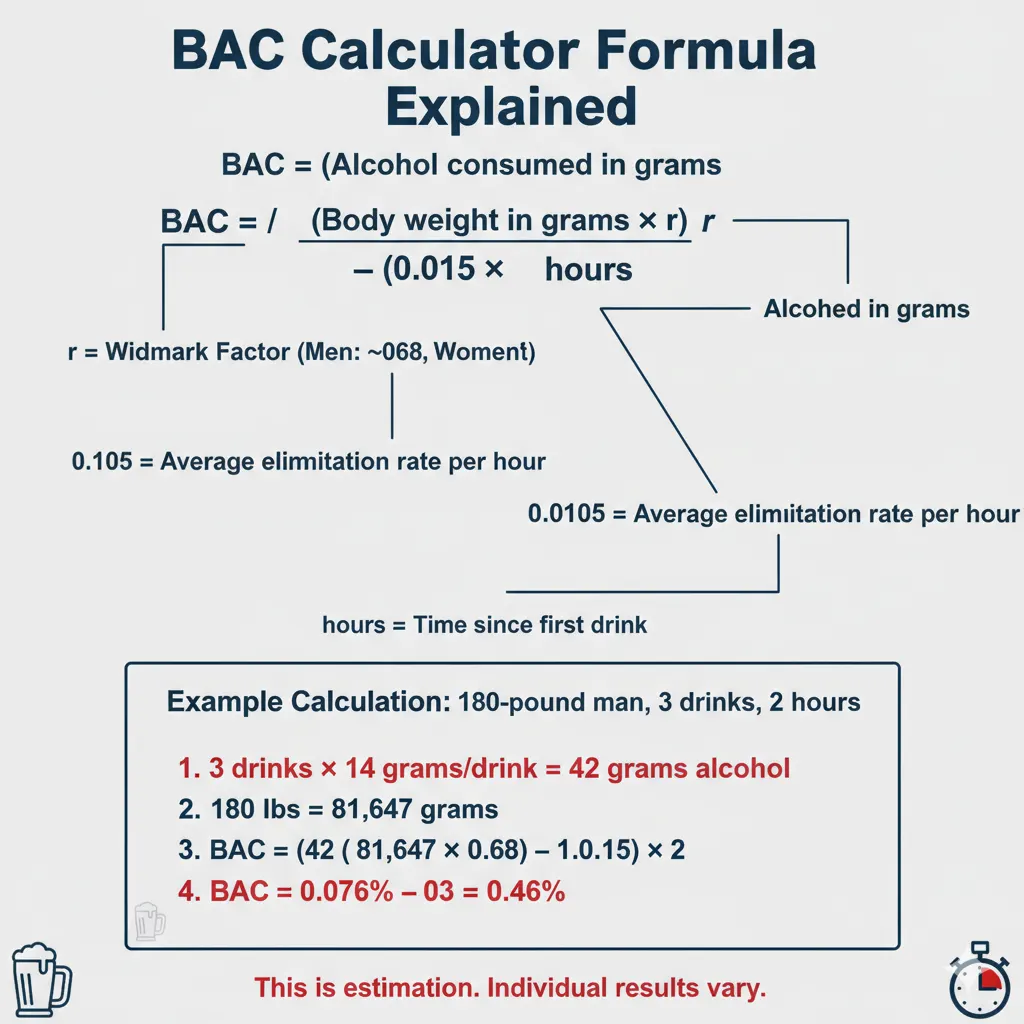
The Widmark formula:
BAC = (Alcohol in grams / (Body weight in grams × r)) × 100 − (β × Hours)
Breaking it down:
- Alcohol in grams — Total pure alcohol. A standard drink has about 14 grams.
- Body weight in grams — Your weight converted to grams.
- r— The Widmark factor. About 0.68 for men, 0.55 for women. Accounts for water distribution differences.
- β— Alcohol elimination rate.
- Hours— Time since drinking began or time elapsed in the model.
So if a 180-pound man drinks 3 standard drinks over 2 hours:
- 3 drinks × 14 grams = 42 grams of alcohol
- 180 lbs = 81,647 grams
- r = 0.68
- BAC = (42 / (81,647 × 0.68)) × 100 − (0.015 × 2)
- BAC = (42 / 55,520) × 100 − 0.03
- BAC ≈ 0.076% – 0.03 = 0.046%
That's ballpark. Real-world results vary.
The formula is an estimation tool. Not gospel.
Why You Need a Blood Alcohol Calculator
"Do I really need this?"
Yeah. Probably.
Here's what it's actually good for:
Planning ahead. Going to a party? Figure out roughly how many drinks will push you past certain levels. Then set limits before you start drinking, when your judgment is still intact.
Understanding your body. You learn pretty quickly that you're not special. That your "high tolerance" is maybe just you being bad at noticing impairment.
Legal awareness. Knowing that two glasses of wine might put you close to the legal limit changes decisions. It should.
Reality checks. That "I'm fine" feeling at 0.06%? You're not fine. Numbers don't lie. Your drunk brain does.
What it's NOT for: deciding whether you can drive after drinking. That decision should be made before you drink. Not after. Not ever after.
How accurate is a blood alcohol calculator?
Reasonably accurate for estimation. Probably within 0.01-0.02% for most people under normal conditions.
But accuracy depends on honest inputs. If you undercount your drinks or guess at pour sizes, the result's off. If you have unusual metabolism, medications affecting processing, or health conditions — results can be way off.
Professional breathalyzers and blood tests are much more accurate. If you need to know for certain, those are the only real options.
Can I use this calculator to determine if I can drive?
No. Absolutely not.
I can't stress this enough. Don't use a BAC calculator to decide if you're okay to drive.
Why?
- It's an estimate, not a measurement
- Impairment can happen below legal limits
- The stakes are too high to gamble on
- Your judgment is compromised after drinking
If you've been drinking, get a ride. Uber. Lyft. Taxi. Friend. Designated driver. Sleep it off. Anything except getting behind the wheel.
The calculator is for education. Not for testing limits.
How long should I wait before driving after drinking?
General rule of thumb: one hour per standard drink. Plus an extra hour to be safe.
So three drinks? Wait at least four hours. Probably longer.
But honestly? If there's any doubt, wait until the next day. Sleep. Let your liver do its job. Then drive.
The "I'm probably fine" calculation isn't worth someone's life. Including yours.
What is considered one standard drink?
In the US:
- Beer— 12 oz of regular beer (about 5% alcohol)
- Wine— 5 oz of wine (about 12% alcohol)
- Spirits— 1.5 oz of distilled spirits (about 40% alcohol)
Each contains roughly 14 grams of pure alcohol.
The problem is real pours rarely match these. That pint glass of IPA? Could be 16 oz at 7% — that's closer to 1.5 standard drinks. That generous wine pour at the restaurant? Might be 8-9 oz.
Count carefully. Most people undercount.
Does drinking coffee or water lower BAC?
No. This is one of the most persistent myths.
Coffee doesn't sober you up. It just makes you a wide-awake drunk person. The alcohol is still in your blood. Your reaction time is still slow. Your judgment is still impaired.
Water helps with hydration and might reduce hangover severity. But it doesn't speed up alcohol elimination. Your liver processes alcohol at a fixed rate — roughly one drink per hour — regardless of how much coffee or water you drink.
Only time lowers BAC. That's it. There's no shortcut.
Are blood alcohol calculators legal evidence?
No. Not at all.
Courts require official testing — calibrated breathalyzers or blood draws done by medical professionals with proper chain of custody.
A calculator on a website is an educational tool. It can't prove anything legally. It won't help you in court. It won't get charges dropped.
If you're facing legal issues related to BAC, you need an attorney and official test results. Not a screenshot of an online calculator.